

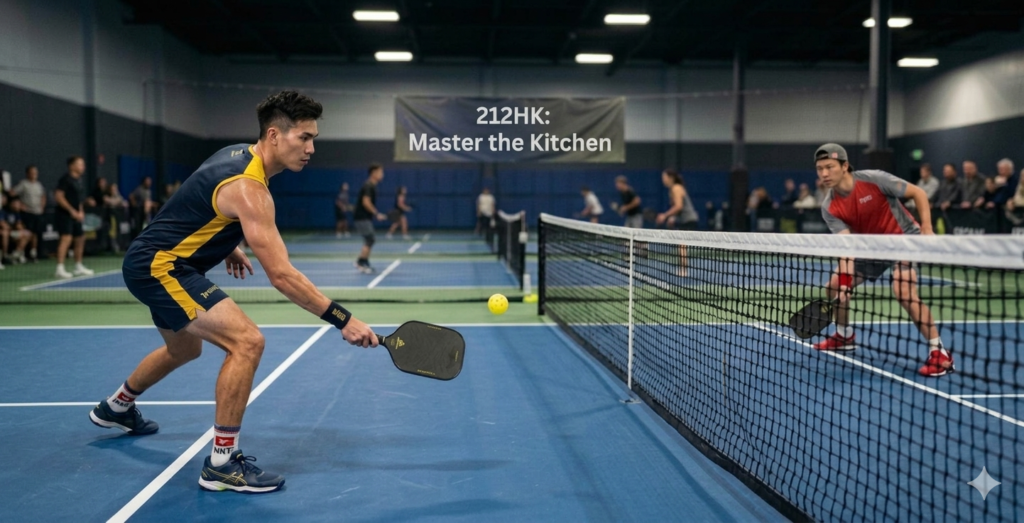
In the high-stakes environment of competitive pickleball, the seven-foot non-volley zone—affectionately known as “the Kitchen”—is far more than a simple boundary line. It is a mathematical battlefield where games are won not through raw power, but through an intricate understanding of spatial geometry. While casual players often view dinking as a mere waiting game, elite athletes treat it as a strategic exercise in limiting an opponent’s options. To transition from a recreational player to a 4.5+ competitor, one must stop thinking about hitting the ball “over” and start focusing on hitting “within” the specific angles dictated by the court’s dimensions.
The Apex and the “Unattackable” Zone
At the heart of pickleball kitchen geometry is the concept of the unattackable ball. The goal of every dink is to ensure the opponent cannot contact the ball on a downward trajectory. This is achieved by manipulating the “apex” or the highest point of the ball’s flight. Mathematically, if the apex of your shot occurs on your own side of the net, the ball will naturally be falling as it crosses the cord. This forces your opponent to strike the ball below the height of the net, meaning they must hit upward to clear it. By keeping the ball below the “Knee-Height Threshold,” you effectively strip your opponent of the ability to “speed up” the ball with pace, as any aggressive strike from that low position would likely result in a ball hitting the net or sailing out of bounds.
The Physics of the Apex: To be unattackable, the highest point (apex) of your shot’s flight path must occur on your side of the net. If the apex is over the net or on the opponent’s side, the ball will likely sit up high enough for a speed-up.
The Bounce Rule: A perfect geometric dink lands deep enough in the kitchen to force the opponent to wait for the bounce, but short enough that the bounce remains below the net cord height.
The Knee-Height Threshold: If you force your opponent to contact the ball below their knees, the laws of physics dictate they must hit up to clear the net, giving you the advantage.
Slicing the Pie: Why Cross-Court is King
A deep dive into court dimensions reveals why the cross-court dink remains the most statistically sound shot in the game. When hitting straight ahead, a player only has 14 feet of depth to work with before the ball lands out of bounds. However, when striking a ball diagonally toward the opposite corner, that distance increases to approximately 21.5 feet. This added length provides a significant margin for error, allowing for more spin and varied heights.
Furthermore, the geometry of the net itself favors the cross-court player; the net is 36 inches high at the posts but dips to 34 inches in the center. By hitting cross-court, you are consistently targeting the lowest point of the obstacle, allowing for a flatter, more aggressive trajectory that is harder for an opponent to volley. This strategy also pulls the opponent away from the center of the court, effectively “slicing the pie” and narrowing the window of return angles they can realistically achieve without hitting the net post.
Distance Equals Margin: The distance from one kitchen corner to the opposite diagonal corner is approximately 21.5 feet. Directly across the net, it is only 14 feet. By hitting cross-court, you are playing into a much larger “landing zone,” reducing your margin of error.
The Net Height Factor: The net is 34 inches high in the center and 36 inches at the posts. Cross-court dinks travel over the lowest part of the net, allowing for a flatter, more aggressive trajectory that still clears the cord.
Reducing the Angle of Attack: When you dink cross-court, you pull your opponent away from the center of the court. This narrows the “window” they have to hit a winning shot back at you, as the net post and out-of-bounds lines act as natural barriers.
The Defensive Shift and Closing the Middle
Understanding the geometry of the kitchen also requires a disciplined approach to defensive positioning, often referred to as “following the ball.” Because the middle of the court is the shortest distance between two points, it is the most vulnerable area for a team to defend. High-IQ teams utilize a “V-shape” defensive shift; when a ball is dinked into a far corner, both players must slide in unison toward that side. This movement closes the diagonal “middle hole” that an opponent would otherwise exploit. By prioritizing the protection of the center line over the sidelines, you force your opponent to attempt a low-percentage, high-skill “down-the-line” winner—a shot that the geometry of the court rarely rewards.
Following the Ball: A common mistake is staying stationary. If your partner dinks the ball to the far left corner, the entire team must shift left. This creates a “V-shape” defensive wall.
Plugging the Middle: Most points are lost in the “Middle Hole.” By shifting toward the ball, you close the diagonal gap. The geometry suggests that it is much harder for an opponent to hit a sharp, winning angle from a defensive position than it is for them to hit a straight shot down the middle. Protect the middle, give up the sidelines.
Footwork and Interception Points
Finally, the effectiveness of these geometric principles is entirely dependent on a player’s footwork and their “toe the line” mentality. Standing even six inches behind the kitchen line fundamentally changes the angles of the game, as it adds six inches of relative height to your opponent’s shots. By staying glued to the line, you are able to intercept the ball at its highest point, often taking it as a volley before it has a chance to drop. This allows you to push the ball back down into the opponent’s feet, turning a defensive situation into an offensive advantage.
The Pivot Point: Instead of stepping directly forward into the kitchen, use a lateral drop step. By keeping your body slightly angled toward the center, you maintain the ability to cover the “Lob” (the vertical geometry) while still reaching the “Short Angle” (the horizontal geometry).
Eradicating the “No-Man’s Land”: If your footwork is lazy and you stand 6 inches behind the kitchen line, you have just added 6 inches of height to every ball your opponent hits. By “toeing the line,” you intercept the ball at its highest possible point, allowing you to push the ball down into their feet.
Manipulating the Opponent’s “Strike Zone”
Instead of just aiming for the floor, aim for their body. By dinking toward your opponent’s paddle-side hip or shoulder, you force them into a cramped “chicken-wing” position. This geometric move jams their arm against their torso, stripping them of the leverage needed to hit an aggressive shot and forcing a weak return.
The “Inside-Out” Dink: By hitting a ball that starts toward the opponent’s chest and fades toward their shoulder, you force them to “chicken wing.” This geometric constraint prevents them from extending their arm, neutralizing their power.
The Short-Angle Fade: This is the most dangerous shot in kitchen geometry. By hitting a ball with heavy topspin that lands near the sideline kitchen corner, you force the opponent to move diagonally and forward. This opens up the entire court for a “down the line” winner on the next shot.
Conclusion
Ultimately, pickleball is a game of managing errors, and the kitchen is where those errors are most often forced. By mastering the apex of your shots, leveraging the distance of cross-court angles, and maintaining a disciplined defensive shift, you move beyond “reacting” to the game and begin “controlling” it.
